
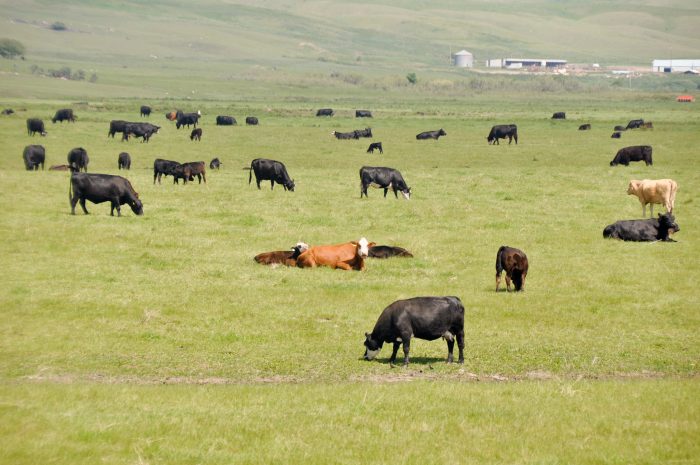
Emissions research part 2: helping cattle feeders reduce their impact on the environment, and on their neighbours
Last week on this blog we talked about a research project that is helping us understand the greenhouse gas emissions from feedlots. We explained why the project was needed and what it studied.
This week we continue our conversation with Dr. Sean McGinn of Agriculture and Agri-Food Canada to find out how the study will help Canada’s cattle feeders minimize their impact on the environment.
Early results
The study showed that 14 per cent of the ammonia emitted at feedlots is redeposited in the immediate vicinity of the feedlot, and reemitted into the atmosphere. “That 14 per cent is a large amount considering a typical feedlot emits one to two tonnes of ammonia per day,” said Sean. However, it is worth noting that the amount of ammonia in the soil decreased by 50 per cent over a distance of just 200 metres.
Sean explained that the implications of this depositing and reemitting of ammonia is a mixed bag of good, bad and indifferent:
-
- Improved crop production – if ammonia falls in soils that are low in nitrogen it can actually reduce the need for fertilizer and increase crop production.
- Damage to ecosystems – when ammonia is deposited to a natural ecological surface – where plants have adapted to a specific nitrogen content in the soil – the loading of these ecosystems with ammonia can disrupt the plant composition.
- No effect on feedlot odours – ammonia concentrations are often thought to contribute to feedlot odour, but the concentrations, even close to the feedlot, are well below the detection threshold concentration (as documented by atmospheric health studies) – feedlot odour is not related to ammonia release.
- Neutralizing of atmospheric acids – when ammonia is emitted into the atmosphere, it can be transported long distances where it has a role in neutralizing atmospheric acids.
- Potential for exacerbating respiratory problems – where the acids are in high concentration (associated with cities) and where animal agriculture is established, there is an accumulation of fine aerosols that causes respiratory problems for people living in the area. This can be seen in the Fraser Valley of B.C.
Moving forward
Feedlot operators are serious about operating sustainably and responsibly. With new measurement tools in place, it means our industry is better placed to minimize its effects on the environment, and also to help inform public policy.
As Dr. Karen Koenig, another researcher at Agriculture and Agri-Food Canada, explains in her article, ‘New methane and ammonia mitigation options in the pipeline’, there are immediate changes feedlot operators can make to reduce the ammonia emissions from their operations:
-
- The amount of ammonia emitted from manure can be reduced by changing the amount of crude protein fed to cattle.
- There are also new forages available that contain substances known to bind nitrogen in manure. “In research we look for win-win results that not only benefit the environment, but also increase efficiencies,” Sean noted. “The retention of valuable nitrogen in manure can result in a savings of thousands of dollars each day in fertilizer costs, while helping reduce atmospheric dispersion.”
To learn more about the research project, check out part one of this series, and be sure to read this earlier blog post, ‘What do you know about cows and GHG emissions?’.


Trackbacks & Pingbacks
… [Trackback]
[…] Read More on to that Topic: cattlefeeders.ca/emissions-research-part-2-helping-cattle-feeders-reduce-their-impact-on-the-environment-and-on-their-neighbours/ […]
… [Trackback]
[…] Find More on that Topic: cattlefeeders.ca/emissions-research-part-2-helping-cattle-feeders-reduce-their-impact-on-the-environment-and-on-their-neighbours/ […]
… [Trackback]
[…] Read More Information here on that Topic: cattlefeeders.ca/emissions-research-part-2-helping-cattle-feeders-reduce-their-impact-on-the-environment-and-on-their-neighbours/ […]
… [Trackback]
[…] Info on that Topic: cattlefeeders.ca/emissions-research-part-2-helping-cattle-feeders-reduce-their-impact-on-the-environment-and-on-their-neighbours/ […]
… [Trackback]
[…] Find More Information here to that Topic: cattlefeeders.ca/emissions-research-part-2-helping-cattle-feeders-reduce-their-impact-on-the-environment-and-on-their-neighbours/ […]
… [Trackback]
[…] There you can find 37280 additional Information to that Topic: cattlefeeders.ca/emissions-research-part-2-helping-cattle-feeders-reduce-their-impact-on-the-environment-and-on-their-neighbours/ […]
… [Trackback]
[…] Read More on on that Topic: cattlefeeders.ca/emissions-research-part-2-helping-cattle-feeders-reduce-their-impact-on-the-environment-and-on-their-neighbours/ […]
… [Trackback]
[…] Read More Info here to that Topic: cattlefeeders.ca/emissions-research-part-2-helping-cattle-feeders-reduce-their-impact-on-the-environment-and-on-their-neighbours/ […]
… [Trackback]
[…] Info on that Topic: cattlefeeders.ca/emissions-research-part-2-helping-cattle-feeders-reduce-their-impact-on-the-environment-and-on-their-neighbours/ […]
… [Trackback]
[…] Find More on on that Topic: cattlefeeders.ca/emissions-research-part-2-helping-cattle-feeders-reduce-their-impact-on-the-environment-and-on-their-neighbours/ […]
… [Trackback]
[…] Information on that Topic: cattlefeeders.ca/emissions-research-part-2-helping-cattle-feeders-reduce-their-impact-on-the-environment-and-on-their-neighbours/ […]
… [Trackback]
[…] Information on that Topic: cattlefeeders.ca/emissions-research-part-2-helping-cattle-feeders-reduce-their-impact-on-the-environment-and-on-their-neighbours/ […]
… [Trackback]
[…] Information on that Topic: cattlefeeders.ca/emissions-research-part-2-helping-cattle-feeders-reduce-their-impact-on-the-environment-and-on-their-neighbours/ […]
… [Trackback]
[…] Read More on that Topic: cattlefeeders.ca/emissions-research-part-2-helping-cattle-feeders-reduce-their-impact-on-the-environment-and-on-their-neighbours/ […]
Comments are closed.